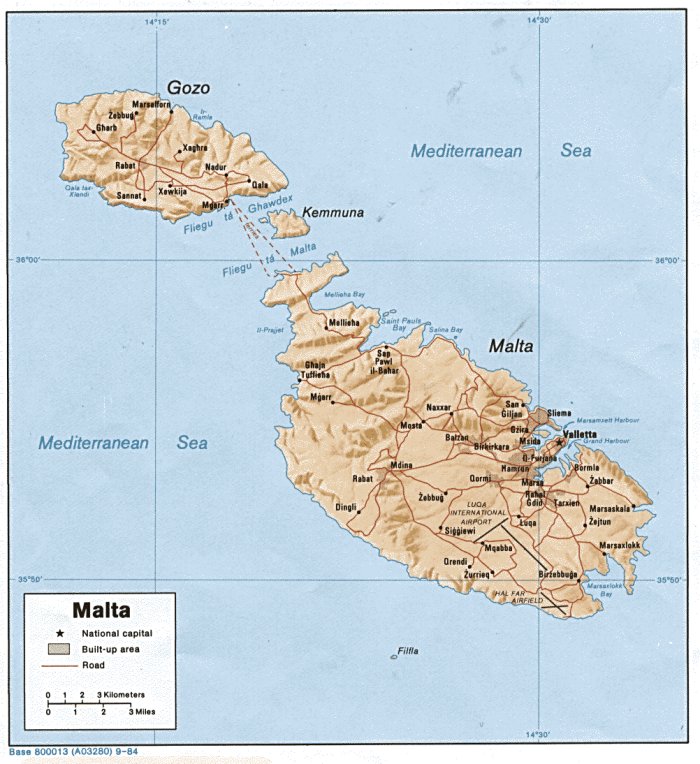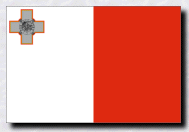
Malta lies in the Mediterranean, 100 kilometers to the south of Sicily and 300 kilometers to the north of Africa. It actually consists of two islands and its capital is La Valetta. Maltese life is heavily influences by a strong Catholic church and the many Holy Orders on that island.
In 1800 the British Navy expelled a French garnison from Malta and the island came under British administration. Malta became British under the Treaty of Paris (1814) and prospered as a free port, used by British shipping to the Adriatic and the Near East. In 1827 it became the base of the British Mediterranean Fleet. A packet service was established in 1832. After the Suez Canal was opened (1869) the volume of shipping increased. By 1905 the Naval Dockyard, together with British defence services, was the basis of the economy.
Demand for independence (though not representation) came relatively late to Malta, which had benefited from the British naval presence on the island. In the mid 1950s Dom Mintoff's Labour Party, then in government, inclined towards integration with Britain. This was confirmed by a referendum in 1956. In March 1962 Malta became internally self-governing.
However, by the early 1960s, with nationalism and anti-colonialism everywhere in the world, together with the decline of the British navy, the mood had changed. The British experience lasted till Malta's independence in 1964. Malta also joined the Commonwealth It has had a strong influence on Maltese institutions. Malta was especially valuable for the British from a strategic point of view.
The country's official language is Maltese, which originated from a mixture of Arabic dialects and Italian. A good way to get an impression of this language is to read these poems or this list of Maltese proverbs, which are all in Maltese and in the English translation. There's also an English-Maltese and Maltese-German dictionary available online.
The English language has not least quite an economic importance for Malta: the island probably has some of the biggest schools for English as a second language, and during the summer months, the islands are packed with foreign students.