CANADA
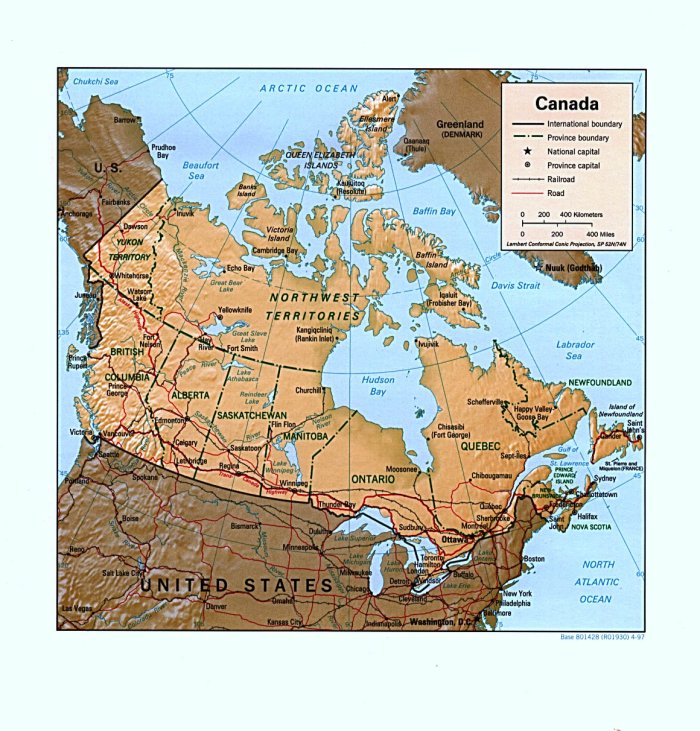
Canada is the second largest country in the
world (9,976,185 sq km). It`s a federation of ten provinces (Newfoundland,
Prince Edward Island, Nova Scotia, New Brunswick, Quebec, Ontario, Manitoba,
Saskatchewan, Alberta and British Columbia).Canada occupies the northern
half of the North American continent and has borders with the US to the
south and the northwest (Alaska).It is bounded by the Pacific Ocean to
the west, the Arctic Ocean to the north and the Atlantic Ocean to the east.
About 30million people (1996) live within the Canadian border. 921,000
(1991) of that number live in Ottawa-Hull, the Canadian Capital. Other
main towns are Toronto (3,893,000; 1991) and Montreal (3,127,000).
The abundance of fish off Newfoundland attracted French, Spanish, Portuguese and English fishermen from the 16th Century onwards. Settlements developed as bases for the fish and fur trade. English settlements developed in Newfoundland and the Atlantic seaboard. In 1791 the country was divided between the English-speaking and French-speaking regions - Upper Canada (now Ontario) and Lower Canada (now Quebec). British North American colonies grew by immigration from Europe in the 183Os-50s.
Official languages today are English and French. 61% speak English only, 24% French only, 16% speak both. Other languages spoken as a mother tongue are Italian, Chinese, German and Spanish (1991). In 1995 there was a referendum about the sovereignty of Quebec, the French-speaking province in Canada.
Another debate is going on about the role that native languages, still spoken by members of Indian tribes, should play.